The Compass in May

Not sure what to write. May is one of my favorite months. The birds are all playing the mating/dating game. The wildflowers are starting to come out. The Ponderosa pine is beginning to offer its gift of butterscotch. Or is it vanilla?
I’m grateful for the Merlin bird app because I can identify the warblers. I can’t remember which song belongs to whom from season to season. But I did hear what I call a “tweet-twoo,” and I thought, Plumbeous Vireo—and I was right. Woo hoo.
A few years ago, I ran around asking my bird people—Lynn Wickersham and Jen Sauter—“Who goes tweet-twoo?” Both said, “I don’t know what you’re talking about.” But then one of them deciphered my butchering of bird language and said, “Plumbeous Vireo?” Lol.
But this May has been hard. Maybe because it’s the beginning of things in Colorado, when you can begin to plant. You still have to be mindful of that late freeze. Mom would have tomatoes and chiles bursting out of her planters in her greenhouse. She’d tell stories about how hot or cold it was, how everything was doing, and how it was all going to freeze anyway, because Mom was quite doomy about gardening. Even as she was the tomato whisperer. My Aunt Bobbi would tease her: “Yes, Theresie, there will be no peas,” as we were shelling buckets of them.
In this new climate, May may also be the last month when it’s cool enough to walk, and even though things are dry, there’s still a hint of moisture in the air. An article in the New York Times talks about what drought and climate change will do to that most resilient of trees, the Ponderosa—that in 50 years our forests may become grasslands. No more snow. The doom continues to grow. This is real doom, unlike the peas.
I remember coming home in May after my sophomore year to spend a couple of weeks with Mom and Dad. I had decided to spend the summer in Boulder. Mostly, I wanted to fall in love, and I knew that wasn’t happening in Bayfield. The drive over Wolf Creek was so green and beautiful. I felt uncertain about going back to Boulder, as if I were caving to fancy, schmancy city things. As I was leaving, I remember Dad saying goodbye by the bridge that leads from the house to the driveway. The bridge survived the fire. He told me that he had lived in a lot of places, and there was no place like Bayfield. He cried. Remembering this still brings an upwelling of grief. But I left anyway. I had a wonderful summer, falling in love with Keith and going to Grateful Dead shows. And here I am. I came home after all, Dad.
I just found out that one of Dad’s oldest friends, Strat Stepan, also died. It feels like such a dying time. Strat hired Gretchen and me to herd his cows. It was great. We’d come home from school, jump on our horses, and ride into the HDs to check on them.
I met an Irish poet, Micheál Ó Súilleabháin, in Monterey. His poem Mixed Blessing starts with:
It will be a long time
before you descend
to predictability. This
hall of mirror becoming
the open plateau.
And ends:
Your compass will still.
It is shuddering
to its pin point.
I thought youth was the time of unpredictability—where to live, who to love, whether to have children, how to make money. I didn’t know that the unpredictability of life comes back around. But here I am now.
I have these young dogs. The Swedish Vallhund and the mutt that has Malinois in her. We call her “the Malinois,” because she sleeps upside down as Malinois do. The dogs, who are aged one and two, play endlessly. They chase squirrels. They sleep with us, even though I would never have even considered sleeping with dogs when I was younger. We love them so much.
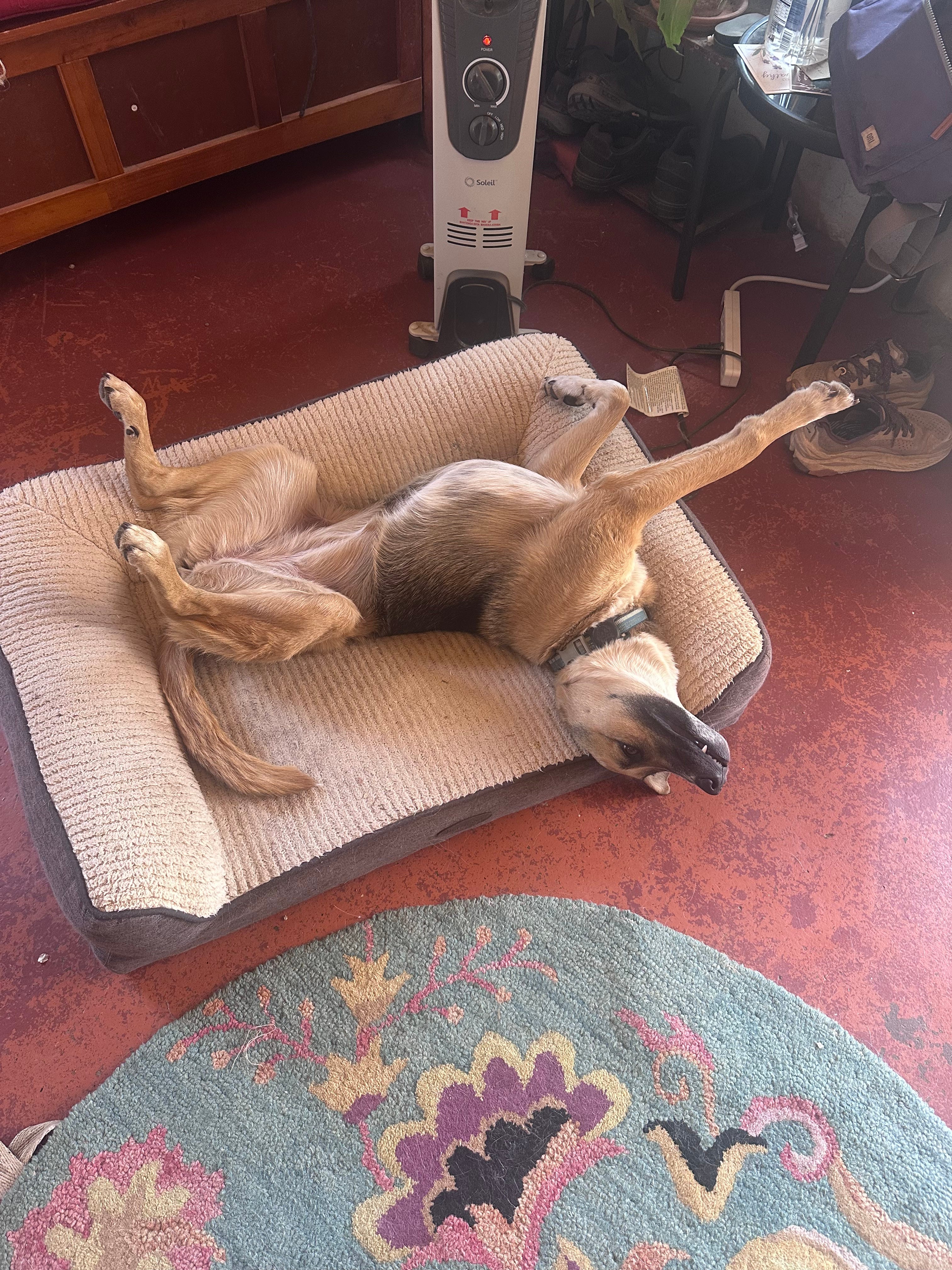
My compass is swinging wildly.
It is a beautiful May.
Sad to learn that Strat died. OMG the memories that stirs. Also, my crazy GSD sleeps upside down like that. She's a total mess, but we love her in spite of her craziness. She's too smart for her own good, or for ours! Love you, Dear Heart. No one misses Jim and Terry like you do, but there's a whole bunch of people who feel that great longing for more laughter and conversations that we can't have with them. We have to settle for memories and conversations about them. A poor substitute, but also a reminder that the breadth and depth of their influence continues.